Labels

Saturday, 6 June 2020

Life in a lockdown – An Insider View

Blog written by Vani Narayanan, a designer by profession and Ram Narayanan, a corporate professional. The couple live in Mumbai, India.

In early February`20, when the corona virus wreaked havoc in China, we were was regularly in conversation with our family friends, official contacts and associates in China. Hearing their experiences in the clampdown in China, we could only empathize with them and were very hopeful that the world would be back to normalcy by early March`20. How wrong we were! Life has returned to normalcy in China but the entire world has been shaken by the Corona virus!!

When the Indian Prime Minister, Narendra Modi, announced the first phase of lockdown in India in mid-March`20, lives of many corporate professionals and business people turned upside down. After all, March is the financial year end in India and is the peak time for economic activity in India. The lockdown not only threw economic activity out of gear in India but also affected the work practices of working professionals, businessmen, gig economy workers and sadly daily wage workers.

As we speak now, the process of easing the lockdown has started in India and jury is out on the pluses and minuses of the lockdown. Nevertheless, the lockdown experience in the past couple of months portends to a different future of work. 

Lockdown adjustment issues have been galore for working professionals

Many corporate professionals, especially those living in crowded cities like Mumbai, have been vouching for work from home (wfh) flexibility for enhanced productivity and work-life balance. 

The present extended has forcefully necessitated an extended remote working but has had its own set of challenges some which are –

·      Getting used to extended remote working with no face to face interactions. Setting up new work processes for remote working and align team members accordingly.

·      Remote working tools like Microsoft teams and Zoom were of great help but issues like clogged networks, IT hardware issues, etc had to be dealt with.

·    Lack of face to face social interactions between employees were replaced by structured online conversations or phone conversations. However, staring into computer screens all throughout the day for all work activities builds up its own pressures as after all the human is a social animal.

·        Lack of wfh enablers – No proper demarcated work space at home (especially in cramped houses in places like Mumbai), family pressures from the household work in the lockdown especially with the mobility restrictions imposed by the authorities. 

·        Prison effect - People who are used to travel regularly and in the creative field, which needs face   to face social interactions, had to adjust to the new reality.

However, there have been many positives from the lockdown too...

Enhanced work productivity making companies happy
ü  Enhanced productivity from remote working busted all myths and perils of wfh. Many companies like the Indian IT behemoth - TCS have announced wfh for a majority of their employees on a permanent and structured basis. In fact, many soft skills-based firms, like legal firms, have plans of reducing their office space areas to reduce costs.

ü  Many core industries companies, especially those with a number of non-IT savvy and anti – wfh employees, have accepted the strengths and advantages of this new era practice. Time and effort saved in commute to work have been converted to enhanced productivity.

Better work – life balance
Lockdown has ensured that many working professionals who led a hectic life and been mostly on the 
move have been able to spend more time with their families. With no
social interactions, travel and other distractions, family activities have
been on the increase. Social media posts of families working out,
family cooking sessions, teaching kids, etc have been on the increase.

Fitness as a way of life 
Runners and cyclists like us had to change exercise routines and adapt 
to the lockdown guidelines. Varied indoor workouts, thanks to our coaches as well as social media,
ensured that we all stay healthy and fit. Many people in our friends’ circle and perennial couch 
potatoes have utilized this time to start exercising and look fitter!! Similarly, online workouts have
been given a boost, which if sustained continuously, will lead to more healthier people on the planet.

Upskilling and reskilling
ü  New hobbies: A foodie like Ram, having tasted different cuisines across the world and different states in India, never ventured into the kitchen ever to cook a meal for the family. The lockdown enthused him to start learning to cook and try different cuisines. Its proved to be a great de - stresser from his professional pressures and of course a great feeling from gaining a new skill.

ü  Online learning: Training and Development teams across organizations have been very active in promulgating online learning.  Thanks to LinkedIn learning, Coursera, etc the opportunities to learn have been vast with online webinars, virtual conferences, etc having mushroomed all across.

Cleaner and Greener planet
ü  In a polluted city like Mumbai, the sight of azure blue skies, birds chirping throughout the day and
   clean and fresh air haven’t been experienced by people of my generation at any time. In the northern parts of India, the Himalayas can be sighted from many cities thanks to the clear skies. The waters of the holy Indian river Ganges, which were polluted by the many industries on this path, have turned crystal pure something which the authorities have been trying to unsuccessfully do for the last 30 years with various scientific options.

Living with limited means
ü With supplies of many items, especially non-essentials being restricted, people have learnt to live with what they have. No fast food items, no going out to restaurants, no movie theaters, no shopping malls. Taking cue from this experience, a permanent reduction in consumption of discretionary spend items can lead to lesser consumerism, lesser pressure on natural resources, better resources spend on essentials like education, healthcare, etc.    

However,  we need to spare a thought for the people adversely affected

While some of the regular salaried corporate professionals can count on the gains from the lockdown and ponder over the work challenges, one should spare a thought for the people who have lost their daily livelihood due to the lockdown.


Daily workers, some of whom have been glamorously christened as gig workers, - Uber cab drivers, pizza delivery boys, restaurant waiters and many more of the same fraternity have been rendered jobless and without any income. In India, with many medium and small firms shutting shop many daily wage migrant workers lost their jobs and, with no money, many of them in fact embarked on a multi-day, long distance walks back to their villages in the scorching heat leading to a migrant crisis.  Many firms especially those exposed to travel, airlines, etc have retrenched some of their personnel.

What are the takeaways for the future of work...

The future world work space will certainly look different as one can’t imagine. A whole new set of practices will surface with more adoption of technology and lesser social and more online interactions. As an extreme thought many firms, like start-ups, may exist only virtually with no permanent establishments. Firms will move with an enhanced vigor for digitization in the post Corona world to meet social distancing norms.

Hence many challenges with spring up in the future a few of which we can foresee-
  • Will any new consumer behavioral trends, from the lockdown experience, lead to a structural change in the jobs market? Will retail consumerism be affected?  For instance, social distancing norms leading to lesser shopping mall visits by people, can led to lesser showroom sales boys and sales girls jobs. A new set of skill sets will have to be developed to meet a new set of job skills.


 ·  What will be the governments policies in this new way of work like taxation of commercial
     establishments
     
     ·   Will newer mode of social interactions among workers effect adversely or enhance innovations,
         path breaking scientific work?

Interesting times ahead for sure certainly. Still then stay safe folks!!


Sunday, 5 April 2020

Corona Virus: “Thinking the Unthinkable” event


When I wrote my last blog “ Thinking the Unthinkable - A new world beckons us” ( https://ramnarayanan1112.blogspot.com/2020/01/thinking-unthinkable-new-world-beckons.html )little did I ever think that the prophecy of the thought would be proved true very soon with the present global crisis due to the Coronavirus.


To refresh the memories, the authors of the book and the driving forces behind the thought, Nik Gowing and Chris Langdon propound the thought that the world is becoming more and more volatile. Very aptly, rather the normal black swan events, Nik and Chris talk about black Jellyfish events- which lurk in the sidelines without catching anybody`s attention and explode suddenly. The Coronavirus has indeed proved to be a black jellyfish event!!!

Two of the main reasons that impede a proper response to these black jellyfish events, as per the authors, are the inabilities of present-day leadership to handle such events. Its mainly attributed to the lack of proper tools and frameworks to pro-actively address these events effectively. On top of these, I would that egos and silo minded thinking of the present-day leaderships have added to the woes in fighting the virus attack.

Events of last 2 months – leadership failures - China, Saudi, USA, Russia, Europe

China started facing the first signs of the deadly coronavirus in December `19 itself but refused to accept the seriousness of the issue and kept it under wraps. Only when the Chinese were faced with a huge number of cases, which could have got blown to huge proportions during the Lunar New year movements, did the Chinese government swing into action. The damage was already done within China and one can only guess whether the numbers and facts that are still emanating from China are completely true!! The Chinese didn’t allow WHO officials to enter China till late February`20, which had they allowed earlier, could have helped the WHO sound off the other governments about the seriousness of the Corona Virus.

The response of the developed western nations too proved inadequate and adds credence to the “Thinking the Unthinkable” theory. The USA president, Donald Trump shouted loud in late February`20 that the USA will not be affected much, and his government is in control of the situation. A month later, the US has had the highest number of virus cases and the government is short of medical supplies.  Trump is at odds many times with one of his top medical advisors Dr. Fauci. Trump, facing an election this year, has put economic agenda ahead of health agenda by not declaring a total lockdown and wants the country`s businesses to start off in full steam by Easter in mid -April. Does he any evidence that the virus will die off by then? Guess not and certainly, Dr.Fauci doesn’t believe so!!!


The Italians and the Spaniards, despite the huge movement of people from China, didn’t take any preventive actions and had to pay the price with the highest fatality rates. The European Union too didn’t come to their rescue, at the most needed time, indicating frictions within the Union. Left to fend for themselves, these countries had to announce a lockdown and take their own actions. Leadership woes in the EU!!!


The financial markets rout was led by the collapse in the oil prices thanks to the ego hassles between the Saudis and Russians and the US. Each wants to kill off the others` oil-linked businesses. The USA needs its shale oil producers to survive and be less dependent on the Middle East for oil, while the Saudis and Russians want to crush the US shale oil business. To support the oil prices post the virus outbreak, the Saudis approached Russia to cut oil production but was rebuffed by the Russians. Due to the poor political relations between the US and Russia at present, the Russians wanted low oil prices to hurt the US shale oil business.


However, both the Russians and Saudis need oil prices to be above $60/bbl to sustain their social spending costs. If no truce is attained on the oil wars, social spending will be cut in Saudi and Russia, which will lead to more suffering for their people while the decline in the US shale oil business will lead to more job losses. Politicians and leaders fight while people suffer!!


Will the leaders arise out of parochial thought process??
I am pretty sure that the global economic and geopolitical scenario will undergo many changes once the world recovers from this pandemic, very similar to the post-world wars scenarios. However, the challenges will be different this time, especially for the political and business leaders, who will face some tough but pertinent questions:

Ø  Will China be the enemy in this war and made to atone like Germany?
With the devil`s advocate theory, that China has fabricated this virus to weaken other countries be proved?  Many leaders have made indirect references to China as the culprit. Unlike Germany which was the aggressor in the world war, China can always claim that it too was affected and has helped in other countries' efforts to fight the virus. China is an economic powerhouse now and is back on its feet now as other countries struggle. Countries will find it hard to ignore China.

Ø  Will firms with high dependence on Chinese supply chains develop a “China de-risking strategy”?
This is a big topic of discussion especially in pharma and automobile companies which have been badly hit. I sincerely hope that firms, as a part of their de-risking strategy, do a “China derisking “activity. No other country today can offer the manufacturing base as China and hence the global firms` movement on this aspect will be slow. Business leaders, with a focus on business recovery and short-term results, will need to take tough decisions in the next 1-2 years to move away from China.

Ø  Will Donald Trump and focus on health rather than the economy?
Trump was planning to run his re election campaign on a booming economy that has been adversely affected now. Will he focus more on getting the virus under control rather than the economy? Will the US people vote now for a socialist-leaning candidate in this election who will focus on health spending?

Ø  Some other pertinent questions that global leaders will face now:
·         Will governments focus more on health infrastructure to help fight pandemics in the future?
·         Will countries like Italy, who had signed up for China`s BRI initiative, give it up now?
·         Will the Indian government move fast and bring in structural reforms to seize this opportunity and make an India as a better alternative to China for manufacturing?
·         Will countries like Japan and Taiwan who have handled the crisis very well be looked up for healthcare systems?
·         Finally, how will the global leaders come together to address the costs of this pandemic especially the lockdowns? Like the UN, which was established after the World War -2 to establish world order- will the IMF and World Bank`s roles are enhanced?

To conclude, global leaders have a tall task now once they recover from the virus. New political and economic orders will have to be established now. New frameworks will need to be developed to tackle the situation which is futuristic as well as sustainable.

Thinking the Unthinkable” prophecy has been proved right with Coronavirus attack. Hopefully, leaders will be able to address the right issues with the right frameworks keeping their partisan interests aside!!!

Till then Stay healthy, stay safe!!


Wednesday, 22 January 2020

Thinking the Unthinkable - A new world beckons us


As we entered the new decade 2020`s, my thoughts flashed back when we entered 2000`s and 2010`s. I tried to analyze and judge as to how this decade can be different from the previous two decades.

The 2000`s was epitomized by the boom and bust cycles. The dot com boom and bust in early 200`s, the commodity boom and bust from 2003 till and 2009 and mainly the financial market boom and collapse. A very beneficial and painful decade indeed! 

The 2010`s was decade of the advent of technology which changed the way business was done and potent signs for the workforce for the future. The rise of FANG (Facebook, Apple, Netflix, Google) kind of firms which have influenced business and political views, the advent of blockchain, IOT which changed business dynamics and the advent of artificial intelligence which blew away jobs. The decade also saw unexpected political events like the election of Donald Trump and Brexit and a stock market book. Again, a volatile period of prosperity and uncertainty!


What will the 2020`s be. One thing for sure is that the world will be more and uncertain and volatile if the recent trends are extrapolated. It will be difficult to make any predictions, with a certain degree of certainty, beyond 3-4 years leave alone 10 years!!

During one of my recent travels I had the privilege of meeting the well-known ex- BBC journalist Nik Gowing and as we started talking our discussions went to a wide range of topics affecting the geo politics from USA – China trade wars, Climate change, events in India and many others.

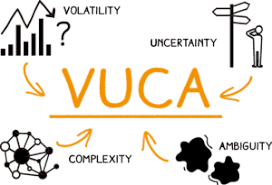
Nik was kind enough to hand me a copy of his recent interesting book titled “Thinking the Unthinkable” which he has co -authored with Chris Langdon. They main point emphasized is that in the highly VUCA (Volatile, Uncertain, Complex and Ambiguous) world, the standard, normal tools and processes that have been used to address and resolve problems will be proved irrelevant and redundant in the new age as can be seen from many events in the near past. 

By presenting a context to the challenges, they drive the point that a new set of tools, frameworks and processes which can help managers to address and successfully take on the challenges of the new world. Some of their major observations are:

ü  The pace of change in the world is furious but isn’t necessarily bad but the results can be far reaching. The #MeToo movement caught up with such a frenzy that it engulfed a celebrity producer like Harvey Weinstein which was unthinkable. Facebook`s growth was unstoppable at one point of time in the mid 2010`s but suddenly got engulfed in the fake news scam and its share price dropped steeply. It took a good amount of management time, including the Senate hearing of Mark Zuckerberg, to address the shortcoming.

ü  Even though fitting a framework to address these challenges are difficult, the authors suggest a five-step sequential process, through which an organization can travel to address the change process– status quo, audit the external reality, audit the internal reality, address the challenges and thrive on changes.

ü  Leaders and managers today are too consumed by short termism and many times are so much in a comfort zone that they don’t see signals of the future. Governments too are blinded by short termism. The water crisis in the South African city of Capetown in 2018 is a good example. In early, 2018 the water crisis became so acute that a “Zero day- when the city would run out of water” was envisaged on 12th April which was averted by severe water rationing. In 2007-08, predictions were made of the impending water shortfall in the city but was avoided due to water rationing and good rainfall in 2013-15. Signals from subsequent rain shortages were met with no counter measures and political tangles at government level, ensured no effective actions, and hence leading to the crisis in 2018.

ü  Managers who have built their careers on conformity and not adapting to changes will find it difficult to cope up. Career Limiting Moves (CLM) which hamper managers career progress needs to be addressed so that they don’t become an impediment for managers to take decisions to adapt to changes. Some of the common symptoms affecting managers are Multiple intense pressures, Institutional conformity, willful blindness, group think and risk aversion.

ü  Apart from the standard Black Swan and Black elephant events, to describe the events which can be disruptive, the authors introduce the concept of black jellyfish events. Like a jelly fish which lurks somewhere and emits toxins, the jellyfish events are those which are simultaneous events which converge with innovation. An example is the like the Russian meddling in the US elections by which they subtly used the social media to plot news against Hillary Clinton without anybody realizing it. 

ü  Some of the changes and trends may not be ethically and politically correct but can change the way people think and act. In the 2016 USA elections, all analysts believed Hillary Clinton won all the three presidential debates but, yet she lost. She claimed that she ran a conventional presidential campaign, but Trump ran the elections shows like a reality show. He was also helped by the Russian meddling using the defamed UK firm Cambridge Analytica. Trump was not the conventional presidential candidate, but he won using questionable tactics. People voted for him!

ü  Senior managers need to look up to the millennials for their thoughts as well as advice. Millennials are not only concerned about the financial performances of firms but also the values and ethical conduct. The movement against climate change is a prefect example where teenage activitists like Greta Thunberg have caught the attention with their actions.

ü  The biggest challenge to leaders today comes from the technology especially from artificial intelligence which will change the nature of jobs as well as the ability to blow away existing jobs. Hence the challenge for the leaders would be to not only how to compete with the challenges of artificial intelligence but how to accommodate artificial intelligence to work with humans and importantly how to control the malicious intents of artificial intelligence. One of the important trends is that these technological advances can weaken the position of a conformist and non-adaptable leader.

ü  Hence firms need to build up cultures, behaviors and mind sets to address these challenges. Some of the traits that very important for managers for the future are having a sense of purpose, value systems, courage and humility.

ü  The way, the famed company Pepsi, addressed the change due to backlash against its “unhealthy” products is a great example. Its CEO, Indra Nooyi, drove the company`s performance with the slogan “Performance with Purpose” and deliver “sustainable long-term growth while leaving a footprint on the society and environment”. 

   
  The company addressed the issue by reducing the amount of sugar, salt and high saturated fat levels in its products. It also lessened its dependence on the Colas and moved towards everyday nutrition products that provide positive nutrients such as grains, fruit and vegetables, and protein, plus products that are naturally nutritious such as water and unsweetened tea. Secondly, it addressed the "guilt-free products" segment that includes everyday nutrition products plus diet beverages and other beverages.


Taking cue from the book, I was inclined to think what the challenges for could be the next few years- Technology march, Artificial intelligence, geopolitical uncertainty- the list is endless.My thoughts were shaken in the first 2 weeks of the year 2020- the assassination of Qasir Suleimani, Putin`s putsch in Russia, have shown what to expect in the next years. 

Can we predict what’s going to happen? Very difficult, though! However, we can be prepared for it by taking cue from the findings of “Thinking the Unthinkable” as slated by Nik Gowing and Chris Langdon.


References:
1.     Thinking the Unthinkable – Nik Gowing and Chris Langdon
2.     Thinking the Unthinkable website - https://www.thinkunthink.org/


Monday, 7 October 2019

My tryst with Himalayas and Climate Change


#sustainability, #climatechange, #environment, #annapurnabasecamp, #himalayas, #pollution, #reuse, #recycle, #reduce,#circulareconomy #Nepal, #Nepaltourism, #gretathurnberg


Last month myself, my wife Vani Narayanan and other friends from my running group in Mumbai, experienced the beauty and freshness of the Himalayas by trekking up to the Annapurna Base Camp (ABC). Over a period of 8 days- 5 days to climb up till ABC and 3 days to climb down, our enthusiastic team scaled an elevation of 4,100m and trekked close to 100kms with steep climbs up along narrow, rocky and muddy but pristine paths laced with breath-taking views of the Himalayas with stunning views of the various peaks like the Annapurna, Macchapuchare and Himchuli. The journey started from Pokhara (Elevation: 1,400m)- Ghandruk (1,940m) – Chumrong (2,040m)- Bamboo (2,190m) -Deurali (3,280m) and finally Annapurna Base Camp (4,100m).


 A breathtaking experience in the mountains....


The trudge in the mountains were inundated with various walks through clouds and splashes along mountain streams with spring fresh water and being treated to the various fresh local cuisines along the way.

For most of us used to staying in 5-star hotels across the world we had overnight stays in various tea houses with minimalistic facilities like cramped rooms for 3 people, common bathrooms, Rs. 200 paid hot shower, no TV, no free WIFI, limited mobile connectivity etc.

As we could carry only limited items due to weight restrictions all of us learnt the values of minimalistic living like reusing clothes for several days, washing and drying clothes overnight under mattresses and sleeping bags, reuse plastic covers, one shower per day, sharing our battery packs for charging our cameras as charging mobiles, etc. was a paid affair, etc. Importantly, instead of buying all our trekking material many of us borrowed from our ever-helping trekking friends’ networks - like bags, jackets, etc. or leased it from a mountaineering shop.

..Laced with some eye opening and humbling experiences

We all huffed and puffed carrying our 5-6 kg day packs along the route but our bags weighing about 10-12kgs were carried by the local porters who could carry about 2 bags each and walk at such a pace that they would reach the destinations well before we all did! Another eye-opening experience that we saw was that all material like some food material, fuel, construction material to the people, houses at the top of the mountains were carried by the local porters with many sights during our trek of these porters carrying LPG cylinders, steel rods, house doors weighing up to 20 kgs on their backs.

A humbling experience indeed for all of us who are used to all facilities and luxuries in life but, yet we complain about many things!! 

Global events in the background

As we were lost in the natural beauty of the Himalayas, at the he same time many events with sustainability and environment issues as the core occurred in the world. The UN climate conference debated the effects of climate change, marked By Greta Thurnberg` s emotional outburst, in which the usual issues of developed vs developing nations clashed with no clear solutions. The Indian government announced a roadmap to weed out single use plastic by 2022 to address the plastics pollutions issue and closer home we Mumbaikars saw the horrible spectacle of trees being cut down in Aarey forest – one of the lungs of Mumbai- overnight to make way for a metro rail shed.

Can mountain people preach climate change?


Obviously, the debate will go on to balance the needs of development to meet the ever-growing needs of people as against the menace due to the unbridled development leading to environmental issues, pollution, etc. which can affect the long-term sustainable development. I reflected to our learnings from the Himalayas trek to check whether these learnings can be applied to our “luxurious” day to day life styles.

Can the sustainability concepts, on which the life style of the people living in the mountains like Himalayas are based, and which our team embraced during the ABC trek – Reduce, Reuse and Recycle be embedded in the mind sets of the people across the world address the climate change and environmental issues?

My gut feel says yes!


What can we people do?

The recent backlash in support of environmental and sustainability issues indicates that this process might have started. Instead of having clothes for many single usage occasions can we all live with clothes just for our utility use and limited other usages and borrow clothes for special occasions? Many of us who spend all our working days in air-conditioned offices, cars, etc. – can we use our clothes more than once before washing and hence saving water usage, soap, power, etc.? Sharing platforms like Uber, Lyft and Ola have shown that we don’t need to own cars to commute. Recycled clothing, even for active sportswear, have been proved to be very similar to clothing made from virgin material from a utility and design perspective. Usage of recycled plastics in roads have proved to be very effective to lay durable roads.

Economic theories driving this change in consumer behavior?


Milton Friedman, the guru of consumption economics, propounded his Nobel Award winning theory of consumption economics in the 1970`s which drove the booming economies of the western world. However, the latest theories of “Sustainability” and “Circular Economy” propagate the perils of unabashed consumerism on the economies and hence highlight prudent consumerism. In short, these concepts highlight that the goods made are resent back to their roots for sustainable solutions and hence leave lesser footprints. If we use the same items more times, reuse and recycle like the people living in mountains do it would lead to a prudent usage of virgin material and hence prudent usage of water, power, fuels, etc. and hence lesser environmental issues and pollution issues and hence lesser climate change issues!

Thus, every policy maker dealing with climate change and environmental issues need to look up to people living in inclement conditions like the people in mountains and look up to them to address the environment issues. Hence at the next UN climate change summit, instead of listening to emotional and content less speeches like the one made by Greta Thurnberg, the organizers would be better off by inviting mountaineers and people living in mountains to speak!!!

Hail Mountains!! Hail Himalayas!!


Sunday, 7 July 2019

Modi 2.0 first budget: Paralleling China`s miraculous growth path

The latest budget presented by the new Modi government has set a very ambitious target for the Indian economy - reach a US $5 trillion GDP figure from the present US$ 2.7 trillion. If the present government targets to achieve this figure by the end of their term in 2024, as proposed, it would mean a real annual GDP growth of a staggering 13%!!!


China growth path, even though not openly admitted by the Indian government, obviously is one of the drivers for this budget. As the saying goes “If you can’t lick them join them “. China`s investment led development model with focus on mega factories, infrastructure, easy access to credit from financial institutions and attracting global investments which was backed by a strong government policy making machinery is evident as one of the key motivators of the Indian government`s initiatives.

Let’s look at some of the intent-based proposals in the budget which are very similar to what China did:

1.    Growth in fixed investment - Mega factories are being encouraged, very similar to the mega SEZ`s that powered China, to boost investment as well as create jobs that will in turn boost consumption. This initiative is also in tune with the “Make in India” initiative of the Prime Minister. However, this initiative is highly dependent upon the private investments which have been facing issues like land acquisition, high interest rates and poor infrastructure issues. External investors, who are being wooed, are still skeptical about investments especially when the global economic front is looking increasingly fragile.

2.    Infrastructure Development - The Indian government wants to give a massive boost to infrastructure - railway sector, roads, ports, airports and power and newly created water distribution. The railway infrastructure, which needs about Rs 50,000Cr, is proposed to be boosted with PPP`s the effectiveness of which however is still under a cloud.  Credit flow from the financial institutions, which are reeling from the excesses post 2009 crisis and the present NBFC crisis, is one of the key determinants for the success of the PPP initiative.

3.    Cheaper credit - China fueled its growth by making its banks lend indiscriminately to the borrowers leading to the wobbly banking sector very similar to what India is also facing now. Hence to bring down the interest rates the government proposes external borrowing by taking advantage of low and negative interest rates in many countries which will help the government to fund its projects at low rates.

4.    Focus on sustainability and green initiatives - Something that China missed and hence paying for its sins with its pollution problems in many cities. The Indian government is incentivizing Electric Vehicles (EV`s) which apart from giving push to the languishing car manufacturing industry will also address the sustainability issues. The government has also proposed a social exchange under SEBI which will address social development issues – something which will ensure a “equitable development” of the society.

5.    Focus on MSME and SME - These sectors are India`s answers to job creation and drive growth especially in the manufacturing sector. The government needs to address the issues of credit flow, labor movement before these sectors can boom.

Challenges that will be faced....

China based on the above model powered itself to the world`s second largest economy by following the above model from the 1980`s which bore fruit from the 2000`s. The Modi government similarly has laid the path for India becoming a $5 trillion economy by taking many cues from China. However, the point to be noted is that China took at least 10-15 years, during which it built its base like infrastructure, before it became a fast-growing economy. Secondly, China was ruthless in implementation of its objectives for which one of the major reasons was the single party rule. India will have its challenges as it’s a full-fledged democracy.

Long time back I came across a saying when I was working with a top-notch consultancy firm – “All strategy documents are a piece of toilet paper unless implemented properly”. The Modi government hence may take cue from it and focus on proper implementation and ground level reach of all its proposals. The ruling party has a majority in the Lower House - Lok Sabha and moving towards one in the Upper House – Rajya Sabha and hence if it has the will, can take India to its cherished dream of $5 trillion economy!

Hope for the best.