Labels

Sunday, 4 October 2015

Governance development in emerging nations. How does India fare?

This paper explores the concept that growth in many emerging countries, are struggling now as they failed to build up institutions which support further sustainable growth. This is one main aspect by which India can hope to outscore its rivals if proper steps are taken especially in implementation of reforms and development schemes and in control of corruption.

The World Governance Indicators (WGI) report ranks various countries on their performance on the governance indicators. The WGI ranks the countries on 6 parameters;


  • Voice and Accountability,
  • Political Stability and absence of violence and terrorism,
  • Government Effectiveness,
  • Regulatory Quality,
  • Rule of law
  • Control of Corruption.

The broad findings of the WGI makes an interesting if not surprising reading. The main observations are:


  1. The world has not significantly improved on governance over the last 10 years!! The last 10 years has seen a period of high growth, a financial crisis and a stagnation and hence this comment spreads across various economic conditions.
  2. The most developed countries are not the best governed e.g. amongst G-8 countries Russia and Italy are not amongst the top ranked countries on many parameters. Some developing economies like Slovenia, Czech Republic, Chile, etc. are well governed countries.
  3. Nordic countries, which score very high on social indicators, are amongst the best governed.
  4. Sustained commitment to governance is required to build up a good governance ranking.
  5. Importantly, any shifts in governance standards in developed industrialized countries can have severe repercussions as was seen during the financial crisis in 2008 in USA. Between 2008 and 2009, the USA score on control of corruption went down by 10% and its ranking slipped by 5 points on this score.

In the last 10 years we have seen many shifts happening in the global economy. In the mid 2000`s, it was the period of the sizzling developing countries especially the BRICS (Brazil, Russia, India, China and South Africa) and other commodity exporting countries like Australia, Malaysia, etc. The developed countries were doing well but all the economic news were full of the turbo charged growth of countries like China and India and it was common to see in all financial and economic newspapers of prediction of future growth rates of these countries and how soon will these countries catch up with the developed world.

As we speak now, the predictions have not come true exactly. The BRICS nation’s growth stories have got stalled. The USA has again become the prime mover of the global economy. It is growing at a steady pace and after many years is looking to increase its interest rates. The shale gas revolution has given a big boost to the US economy with many manufacturing activities shifting back to the USA. Germany`s economy remains robust with its manufacturing business aided by low energy prices and similarly Britain too is showing signs of recovery. Thus we look to be going back to the mid 80`s when these developed countries ruled the roost.


Many reasons can be assigned to the stagnation faced by the star economies of 2000`s especially India and China. One of the questions to be asked is whether these economies have invested enough in building up the enablers for sustained growth like the developed economies. On some of the indicators like education and infrastructure, probably yes but what about institutional strength which is a key building block and an enabler for sustained development? Governance indicators reflect the performance of the nations on institutional development. 

Comparison of India and China

In the recent past, with all kinds of issues in China many comparisons have been drawn between India and China which shows how India is better placed than China. As reported in many places India`s forex reserves are comfortable, GDP growth rate is at 7%+, a stable democracy with a pro- business government and enough room to cut rates to stimulate the economy, etc.  which gives it an edge in the immediate future. What kind of progress have India and China made on governance indicators over the past 10 years? 

The WGI rankings show that China outscores India in 4 out of 6 parameters with India ahead in Voice and Accountability and Rule of Law.

India being a democracy with more democratic rights for people as compared to one party rule in China which suppresses any rebellion and people`s rights, it’s obvious India will score far more than China in Voice and Accountability aspect.

 In political stability China being a one party dictatorial rule, even though very opaque, with no opposing parties scores higher. Secondly, India is a federal system with many powers devolved to the states, multiple political parties and with militant problems in many areas faces the threat of political stability even though it has a had a democratically elected governments at all times except in emergency time. The Chinese government, right from Deng Xiaoping, even though socialist in name was capitalist in thoughts. In pursuit of economic growth, the Chinese government has been very effective in implementing growth oriented policies like building of infrastructure, export zones, etc. At the same time successive Indian governments, even though focussed on growth, have got bogged down at many times, some due to democratic system issues and many due to inaction (like the UPA-2 government) and hence China scores more than India in Government Effectiveness.

 For similar reasons on regulatory quality, which is a reflection of a government`s ability to implement its policies for private sector development, China has been able to outpace India with the gap getting wider between 2009-13 during the ineffective days of the UPA-2 government.  

 Legal implementation and legal rights to businesses have always been a problem in China for all multinational firms. China adopted a legal system just before it opened up in 80`s but the effectiveness of the legal system has always been suppressed and bypassed by politicians and firms with strong political connections. Protection of Intellectual Property Rights, especially in technology, has always been a sore point with western firms operating in China. As compared to that India has had a very good legal system with effective control with the biggest advantage being that the Indian legal system, being adopted from the British system, is compatible with all western legal requirements. The Indian courts have not shied away from taking strong positions either in political or key business issue (like the 2G scam ruling) acting as an effective control on the legislature and thus India scores very highly against China on Rule of Law.

 Both India and China suffer from rampant corruption which is deep rooted. Due to lack of proper institutional strength China has faced massive issues on the corruption front with the opaque governmental processes leading to many issues on corruption. However with many corruption issues getting highlighted in both India and China, owing to media and people pressure, measures have been taken to control corruption. After the 2G scam in India and the Aam Aadmi movement, the present government has taken steps to reduce corruption especially at government level. Similarly in China, the Xi Jinping government and the previous government has been cracking down massively on corruption. The UPA-2 government time was mired in scams and thus India has lost ground to China since the late 2000`s to China on the corruption control front.

How do BRICS countries fare against the developed countries?

Being emerging nations one would expect that the average rankings of the BRICS nations should show an ever improving trend. On the contrary the BRICS average governance rankings have remained almost the same and on the contrary on the 2 important parameters of regulatory quality and control of corruption, the rankings show a downward trend which shows that these countries are still weak on the governance front. India too shows a downward trend on these 2 parameters with China showing improvement on the rule of law and corruption control front.

India scores well above the BRICS average on voice and accountability and in rule of law. India is ranked lower than the BRICS average on political stability, regulatory quality and control of corruption.

Let’s see how India and China fare against the other BRICS countries and the perennial stars G-8 countries (without Russia and hence referred to as G-7 in this paper). The stark observation is that the G-7 countries are way ahead of the BRICS countries on all parameters. The developed nations have built up sustainable institutions and frameworks which acts as a check as well as a good platform to sustain and remain continuously on the growth path. In fact the G-7 rankings have been pulled down to a significant extent by Italy, which given its issues with its unstable governments and deep rooted corruption, has always been low on the governance rankings.

Amongst the BRICS countries, apart from India and China, Russia and Brazil have seen a major collapse in their economies, after the oil crash, as well as due to various misgoverns deeds. In Russia, Vladimir Putin has destroyed and made redundant various institutions in order to further his grip on the country. He has also isolated Russia with the Ukraine issue and the oil crash has severely dented Russia`s finances. Similarly, severe corruption cases in Brazil, like the Petrobras scam, have dented the governance institutions in the country and again the oil crash has only aggravated the issue. South Africa, despite a stable political government, is still grappling with issues related to the black minority and violence in the rural front and hence many governance institutions are still weak.

Imperatives for India
India`s democracy with high degree of freedom of speech and a good legal system are the major positives. The weak governance skills, corruption scandals and poor implementation are the major negatives for India.

What should the Indian government do?

  • At present India has got a strong government at the centre with a vision for implementing reforms. Given the federal framework in India, the states play an important role and in the last budget the government has devolved more power to the states. Hence it very important for the Indian government to ensure that the various channels for implementation of schemes be charged up at the state level.
  • The bureaucracy has a major role to play in implementation and hence needs to be charged up and protected for effective implementation of development projects.
  • The Indian government has been cracking on corruption and black money holders as stated earlier. The government should be ruthless in tackling corruption.
  • India has got very good governance institution as compared to many other countries like the judiciary, financial regulators like the RBI, SEBI, etc. The integrity of these institutions shouldn’t be compromised. The actions of the RBI, in face of turmoil in the financial markets, have been exemplary as compared to the other central banks.

The actions of the Indian government over the past one year on governance, especially on implementation, has yielded some results with the latest World Competitiveness Rankings pushing India up by 16 notches.

So Mr. Modi, implementation and corruption reduction which you have been emphasising about needs to be ruthlessly followed up for India to move up to the annals of the developed nations!

Sunday, 5 April 2015

Migrants are a value enhancement proposition to a nation

Bloomberg carried an article on 27th March `15 which claims that if all the migrant [i] controls globally were removed then the global GDP can increase by 67% - 147%! Freer flow of people can add more value to an economy as compared to a free flow of goods and controls on movement of people is the “last frontier of globalization” which however has shown least progress, claims the article. I am slightly inclined to agree with this claim if I look at the top ten countries in terms of migrant population. Out of the top ten countries, seven countries are developed nations (viz. United States of America, Canada, United Kingdom, Germany, France, Spain and Australia). The highest ranked country is the world`s biggest economy – USA.  Right from the Mayflower pilgrims who set foot in the USA to immigrants fleeing oppressive regimes to skilled people looking for opportunities, the USA is the top preferred choice of migrants. USA has been able to leverage the skills and abilities of the migrant populace to enhance the nation`s development.

Migration – benefits and flow pattern
The United Nation`s department of economic and social affairs report of last year reports a global figure of international immigrants at around 231mn which is about 3.3% of the world population with the developed nations accounting for close to 60% of the immigrants stock. Females account for 48% of the migrants and interestingly the developed nations` immigrants stock comprises of 51% of women. Refugees account for close to 7% of the migrants and 87% of the refugees are accounted for in the developing countries.

The major benefits for a migrants receiving country are:
a)    Migrants add to the economic growth of the country with their work and savings.
b)   Migrants bring specific skill sets which help in the economic development
c)    In case of ageing populations, migrants help in maintaining the ratio of the working population.

The major benefits for a sending country are:

  1.  Remittances that the migrants make back to their countries
  2. Ease the employment pressures in their home country.
The key trends for migrants flow are:

  1. Migrants flow follows economic development as majority of the migrants would move to places     mainly in search of work.
  2. Apart from work the other critical factor for migrants` movement is preference to move to places which has a culture to integrate migrants and effective laws and systems (viz. social benefits) to protect them. Hence the western world, which is high on governance and law and order systems, is able to attract skilled migrants in good numbers on a sustainable basis.
  3. Women migrants prefer to move to countries where they have working conditions conducive for  work as well as safe to live and work. Conservative Muslim country Saudi Arabia which is a top 10 migrant country has only 29% of women migrants.

Do migrants add economic value and productivity of a nation?
Boubtane and Dumont in their research paper noted that the main advantage of migrants flow is human capital formation and disadvantage is capital dilution. Their research on 22 Organization of Economic Co-operation and Development (OECD) countries showed that the advantageous human capital formation exceeds the disadvantageous capital dilution but by a small amount only. A 50% increase in net foreign born migrant stock increases the productivity of a nation by less than 0.1% but this increases with more selective migration policies. Countries generally follow immigration policies to address their specific needs and wouldn`t try a mass migration policy. Many countries, especially the western nations, have a focused immigration policy to build a sustainable work force with varied skill sets. Countries like UK, Denmark, Australia, etc. attract skilled migrants through a points based selection system.


The productivity potential of a country are nowadays indicated by the Competitiveness of a nation (hail Michael Porter) and the new buzzword in the last few years “Innovation”. To understand the effect of immigrants movement on the economic development of nations, two key rankings of a country`s progress viz. World Competitiveness and Innovation Rankings were analysed.  An analysis of the migrants’ flock of population of the top countries, as shown in table no. 1 &2 shows that the top 100 nations have a higher proportion of migrants as compared to world average, which is expected as the top countries would also have higher economic development. The top competitive countries show a significantly higher proportion of migrant population and also the top 20 nations also show a higher female migrants proportion. A similar trend is also observed in the top countries based on the innovation rankings also.


These trends are in sync with the reasons behind the migrant flow of economics, stature and societal acceptance of migrants. These trends show that there does exist some positive correlation between the migrants and the economic growth and growth potential of a nation. What could be the possible reasons? Migrants, based on their requirement of work and to survive, have to be competitive with the local population, if not more, and hence add a significant value to a nation`s development. Secondly, in case the migrants take the lower end jobs it frees up the existing local population to focus more in higher end jobs and thus contribute more to the country.

Are similar trends seen in top migrant nations?
A look at the migrant structure of the top 10 migrant nations (viz. USA, Russia, Germany, Saudi Arabia, United Arab Emirates (UAE), UK, France, Australia, Canada and Spain) shows some similar but interesting facts as shown in table no.3  All the countries have a higher proportion of migrants as compared to the global average of 3.2%. All nations also have a higher proportion of female migrants with the exception of Saudi Arabia and (UAE). These two countries are Muslim conservative countries where women`s right to work and freedom of movement and speech are highly restricted thus showing a very low proportion of female migrants.    


The analysis of key growth potential indicators i.e. GDP,Competitiveness and innovation rankings, Labor participation rate[ii] and tertiary education of the top 10 migrant nations, as in table no.4, throws the following facts:


  1. All the top migrant countries are ranked in the top 30 in terms of GDP and only UAE is marginally behind at 32nd rank. 7 countries are ranked in the top 30 countries in terms of GDP per capita.  
  2.  Eight countries are ranked in top 25 in Global competitiveness rankings and 6 countries in top 25 in innovation rankings.
  3.  Interestingly, seven countries have a labor force participation rate lesser than the global average of 60% despite that fact that almost all countries have even a tertiary education rate[iii] well  above the global average (Again conservative Saudi is just above the global average and no data available for UAE).

These trends reinforce the following facts:

  1. Countries with high migrant population are generally very well off economically and on growth potential. Migrants mainly move for jobs and hence do play a very important role in the economic development. If the migrants aren`t contributing then they would be out of work very soon. Migrants imbibe the same attitude in their children and hence this competitive urge is built up in the next generation as well.
  2. If a nation is high on the competitive index, then certainly the labour force effectiveness would be on the higher side whether it is local or migrants. Again migrants would have to be on the higher side of competitiveness to survive and hence would be playing a major role in enhancing the    competitiveness of the work force.
  3. The innovation rankings of the top countries are slightly lower as compared to competitiveness rankings. The lowest ranks go to the Muslim conservative countries Saudi Arabia and UAE which are highly dependent on oil and associated service businesses respectively and hence aren`t inclined to move much on the innovation curve. Secondly, these two countries are lower on the tertiary education also which is a key driver for innovation. On an average the top 10 countries on innovation rankings average about 60% in tertiary education.
  4. Most of the developed nations like USA, UK, etc. are battling lower labor force participation due to various factors like ageing population, social benefits, etc. With declining and lower child birth rates, these countries have to follow a pro-active immigrants’ policy to drive their economy   as well as productivity. A few months back US president Barrack Obama announced a new immigration polic on the same lines.
The basic resistance to migrants flow comes from the domestic political compulsions in a nation. Free movement of people will be brutal to any labor force as it would necessitate constant upgradation of skill sets to survive and social implications also. Politics will dictate how much migrant flow will happen.

Practically, the basic things that a country can do to encourage movement of migrants are

  1. Allow free movement of labor across industries. Restrictions of any sort will only impede growth.
  2. Build up legal systems to protect rights of migrants.
  3. Keep xenophobic tendencies under control.

Finally, to answer the question whether the world should allow free movement of people the answer theoretically is a big yes. Migration has a definite positive effect directly and indirectly on the GDP growth and the competitiveness of a nation. The top nations in terms of competitiveness and innovation have a higher proportion of migrants. Secondly, the top migrant recipient countries have very good indicators in terms of GDP, GDP growth, competitiveness and innovation indices. A higher ratio of female migrants also has a higher degree of correlation with the development indices.

Thomas Friedman in his famous book “The world is flat” encourages free movement of goods across the countries without barriers. The next wave is free movement of people. Tougher to implement but will lead to a better world!


References

  1. Ekrame Boubtane and Jean-Christopher Dumont. Immigration and economic growth in OECD countries 1986-2006: A panel data analysis
  2. Bloomberg (27th Mar`15) Here's One Way to Double the World's $80 Trillion Economy: Scrap Migration Restrictions
  3. Global Competitiveness Report 2013-14 – World Economic Forum
  4. The Global Innovation Index 2014 – Human factor in Innovation : Johnson Cornell University, INSEAD and WIPO
  5.  Economic Effects of Migration – SUNY 2015, The Levin Institute
  6. The economic implications of changing age structures – Ronald Lee, University of California at Berkeley.
  7. International Migration 2013 (chart)- United Nations, Department of Social and Economic Affairs, Population Division
  8. Is Migration good for the economy- Migration Policy Debates, 2014
  9. Population Facts, 2013 – United Nations
  10. World Bank database – www.worldbank.org


[i] Migrants; International migrant stock is number of people born in a country other than that in which they live. It also includes refugees. 

[ii] Labor Participation Rate; Labor force participation rate is the proportion of the population ages 15 and older that is economically active: all people who supply labor for the production of goods and services during a specified period.

[iii] Tertiary Education Rate ; Total is the total enrolment in tertiary education (ISCED 5 and 6), regardless of age, expressed as a percentage of the total population of the five-year age group following on from secondary school leaving.

Friday, 13 February 2015

Aam Aadmi People`s Party (AAP) victory in Delhi elections: what it means for political re-alignment in India


In my blog a couple of weeks ago (http://ramnarayanan1112.blogspot.com/2015/01/political-re-alignment-in-india-post.html) I had touched upon 3 major points:

1.    The political platform of India has shifted with the pillars being development and governance. These shifts look difficult to reverse.
2.    The BJP`s juggernaut is rolling on based on the above platform.
3.    An effective opposition is very much required for effective political governance.

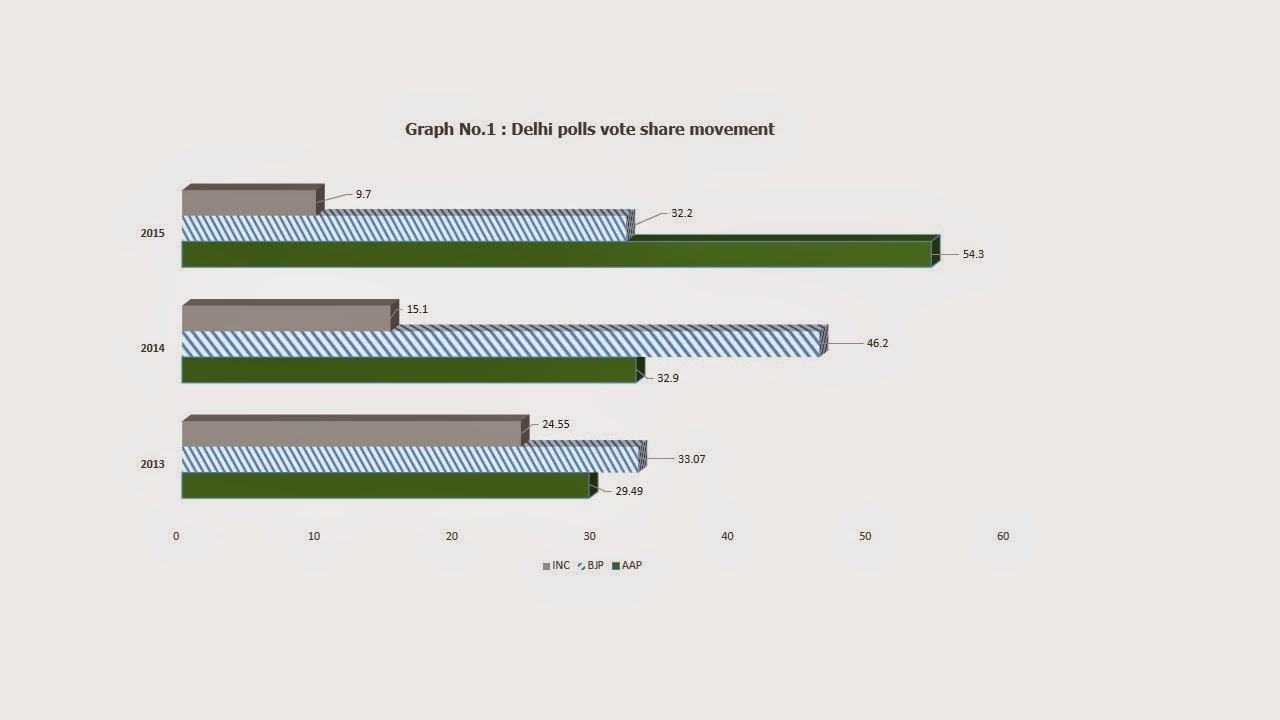
The Delhi elections in which the Aam Aadmi Party (AAP) with a score of 67-3 have reinforced 2 points and effectively disproved one point. Wrong ones first. The BJP, whose juggernaut was rolling on, was trumped up by the AAP which focused on effective governance. The Congress Party has been wiped out totally. AAP has been able to effectively communicate its message of effective governance better than the BJP and hence have been voted in by the people of Delhi. Graph no.1 which shows the vote share movements in the last one ad half years shows that firstly AAP has gained in the 2014 elections at the expense of Congress from the 2013 elections and secondly in the nine months since 2014 elections the BJP vote share has declined and back to the same level as the 2013 elections. Hence AAP has been able to effectively halt the BJP juggernaut.

The elections proved that development and governance platforms have been strengthened further and here to stay. The Congress which had no base of development and governance has been wiped out with not a single seat in the Delhi assembly for the first time ever. The fact that the people of Delhi have given a sweeping mandate to AAP, after giving them a thumbs down in the Lok Sabha elections 9 months back, shows the confidence on the message of governance communicated by AAP. Governance probably plays a bigger role in Delhi, as being the national capital of India, it is comparatively better developed and has the best infrastructure in the country but poor law and order situation and high corruption at all levels. This probably means that governance in day to day life is high on the important issues for Delhites. This issue was addresses by the AAP`s 49 day rule last year with initiatives like anti-corruption hotline and midnight raids, etc. and hence been able to reap the rewards of the people`s requirements.

Till the Delhi elections, the space occupied by the opposition was getting squeezed by the BJP with successive election victories, since the last Lok Sabha polls. The Modi – Shah combine was considered invincible. With the AAP win in Delhi, we now have a semblance of an opposition party which can play the role of an effective opposition which is very important in a democracy. AAP, having won on a platform of governance, conforms to the politically realignment theory of development and governance platform. The other opposition parties like the socialists, TMC, etc. have been greatly enthused by the road block posed to BJP. They should however realize that they can play an effective opposition and win the people`s mind share only if they re-align to the new political platform of governance and development. The prospect of AAP playing a major national role immediately is very distant as it’s still confined to some pockets in India only and will take time to build up a national base.

What should AAP do meet the expectations of the massive mandate they have got:

a) Recognize that governance works well on a long term basis only when combined with development. Highly populist measures will erode its platform in the long run.

b)  Focus on reducing corruption, as they did previously, and make people` day to day life easier.

c)    Keep up its election manifesto promise on good infrastructure and recognize that it is now a birth  right of the people.

d)   Please don`t be anti-industry. Finally industrial development, in a proper manner, is what can lead to development.

The hallmark of the well-developed western countries is development and governance. For long Indians have been put on a socialist and populist agenda which has ensured neither of the two. Even during the phases of development like the 90`s and 2000`s governance levels have been abysmally low. For the first time in the history of India we have a ruling party focused on development and a ruling party in a state focusing on effective governance.

Let us hope that this political re-alignment juggernaut moves along and makes India a truly developed nation.


Friday, 16 January 2015

Political re-alignment in India- post 2014 elections

After the general elections in India last May, when the BJP won with a thumping majority, I wrote my blog “India at the edge of a dramatic change in political governance “(http://ramnarayanan1112.blogspot.com/2014/05/india-at-edge-of-dramatic-change-in.html).  The BJP won with a majority on a Modi wave. Most of the people were very positive that the new government would usher in changes to cater to a new India and the aspirations of the younger people. I had written that the 2014 elections was also a watershed election in which new trends were visible the most important of which was that Indian politics is tilting towards development and governance politics.

More than 6 months after the new government has taken over the optimism and enthusiasm continues for the BJP government. Despite some fears of “too much hype and less action” the development and governance agenda put forward by BJP is still the talk of most of the people. After the successful national victory, the BJP juggernaut has rolled on the platform of development and governance with victories in Haryana, Maharashtra and other states. The successive election victories of BJP has shifted the centre of political power to the rightist and pro-capitalist platform. The people of India, through exposure from the social media and a borderless world, want better living standards and life styles and not get caught in a quagmire of dogma and slogans.  Unless the BJP falls flat on its development agenda or there is major shift in the aspirations of a major section of the people there are no visible reasons why this shift would be reversed.

The shift in the political centre of power has caught many of the other political parties on a wrong footing and most of them are in disarray with these tectonic shifts. The left oriented Congress party has been thoroughly thrashed in all the polls and as of today they rule only in 3 states viz. Karnataka, Assam and Kerala. Their socialist, welfare oriented and freebie policies and anti- business stance has been given a resounding thumbs down by the people.  The lack of development in the UPA-2 rule and confused leadership of the Congress has shown that they still haven`t understood the growth and development aspirations of the people and is reflected in their continued losses in the polls. The socialist and Lohiaites (RJD, SP, JDU, etc.) have recently come together to form a socialist and anti-BJP front which is nothing more than an opportunist front and nothing to do with growth and development.  The Communist Parties have been virtually decimated. TMC and BJP are the main players in Bengal and in Kerala the communists are an opportunistic player. The regional parties have been winning votes by mainly playing with the local sentiments. The BJP, using its development agenda and Modi as their mascot, has made inroads in Bengal, especially North Bengal much to the chagrin of the TMC. The TMC was voted to power in the hope that they would reform Bengal which had stagnated for decades under the communist rule. However the TMC has proved to be a rabble rouser rather than a performer. Similar is the case in UP with the Samajwadi Parties non-performance.

Is this shift in the political alignment sustainable? I would think so due to the following reasons. The PM, a proven task master, has built up his election campaign on development and governance and hence any lack of effort will show him in poor light. On a similar plane, lack of performance by the BJP will surely hurt them badly in the next elections. Importantly, the majority of Indian people are eager for development and hence will support politicians who prove their development credentials. Finally, the international community is looking upto India as a shining path in the bleak economic scenario and hence India would very well like to grab the chance to catch up for lost growth.

What should the present government do to sustain and build upon this shift in political alignment?

a)  Most importantly deliver on its election promises. Focus on infrastructure and day to day hassles of people like travel, availability of power, water, food, etc.

b)The rural people are the most susceptible to the freebie culture. Hence focus on development in rural areas and importantly focus on primary education and skills development for employment.

c)  Business friendly policies to stimulate and sustain investment and hence more jobs for the young people.

d)  Be harsh in tackling corruption.

Finally I would like to touch upon an important issue on political governance. One of the most important pillars of democracy is an effective opposition. Given the state of the opposition parties as discussed earlier are there any chances that they will change with the new re alignment in the political scenario? It is possible like the way Tony Blair turned around a moribund Labour Party in the 90`s to election success in UK. The main party Congress needs some fresh blood and clarity in leadership which is lacking as of now. The regional parties are running helter skelter with a few exceptions like BJD, TDP which are aligned with the centre. The socialist outfits are dogmatic and opportunist. What about the poster boy of last year- AAP? We have heard lectures on governance but unless we see performance they would also be categorized in the same barrel of apples as others.


Let`s hope for the best from this government and hopefully the political re-alignment makes our lives better.

Monday, 13 October 2014

“Trendsetters” that have changed cricket

I was going through my childhood collections of stamps, comics and other “trash” which my father ordered away from his house to be moved immediately to my residence else be prepared for it to be thrown out! One of my favourite hobbies was a scrapbook of pictures of cricket matches and players’ pictures from newspapers and magazines of the 1980`s. As I rummaged through my collection which had pictures of my favourites like Kapil Dev, Sunny Gavaskar, Wasim Akram, Denis Lillee, David Gower and many more, I was forced to think how much the game of cricket has changed since the 1980`s when the West Indians were the champs and Channel Nine was the best broadcasting station.

As far as I can remember, a few “trendsetters” have changed the game of cricket over the last 30 years which I am inclined to discuss.

1)    Advent of limited overs game
A single one day game from a washed away Test Match, between Australia and England in 1971, changed the face of cricket. One dayers made the game more exciting, quicker and spectator friendly as compared to Test cricket. Rather than spending 5 days watching a game with a high probability of no result, people lapped up the one dayers with great spirits. Cricket was probably the only game with no world championship till 1975 when the first one day world cup was played in England. One dayers also lifted the standards of the game especially in fielding and power hitting. Some players who were good fielders, unorthodox but quick scorers got the nod to play and not in tests. Krish Srikkanth used to play in one dayers before he became a permanent player in the Test side over players like Anshuman Gaekwad and GR Vishwanath. One dayers also forced many test specialists to modify their game to suit to one dayers. A great example is the Indian maestro Sunny Gavaskar who once scored 36 runs in 60 overs but adjusted to the one dayers beautifully. Fitness levels also went up due to the fast paced nature of the game. The advent of one dayers naturally had a reverse effect on Test Cricket wherein teams started playing more positively to win rather than draw matches by scoring faster, fielding more athletically and better players` fitness.
Teams initially used one dayers as a practice for Test matches and hence the same team composition was used for both one dayers and Tests. With the increase in number of one dayers, more specialization came in and teams started using different players for different formats. One days specialists like Michael Bevan and Ajay Jadeja, who otherwise were not regulars in Tests, were regulars in one day sides due to their quick scoring and fielding.

2)    Kerry Packer`s circus
Kerry Packer threw the entire cricket world in a tizzy in 1977 by making most of the leading players sign up for his “pyjama cricket circus”. He also revolutionized the game by introducing coloured clothing, night cricket and multiple TV cameras with Channel Nine broadcasting. One dayers got more glamorous and hence more viewership and better pay for the players. The Kerry Packer circus also meant that for the first time players could stand up to the cricket administrators and demand their pound of flesh.


3)    Shift of global power centre to India
World cricket administration was dominated by England and Australia ever since the advent of cricket. Since the mid 90`s the BCCI has marketed the game beautifully in India such that that India now generates 75% of the global cricket revenues. Shrewd administrators like Jagmohan Dalmiya, IS Bindra and of course the marketing whiz kid Lalit Modi, who started IPL, cashed in on the huge popularity of cricket in India and built up a big commercial value to cricket. The shift to India made cricket a huge commercial venture like EPL and NBA.

4)    Advent of T20 and IPL
After one dayers and commercialization of one day cricket, the next biggest trendsetter has been T20 cricket which was furthered by the launch of IPL in India and similar leagues across the world. Cricket matches became quick and short like football matches. One could watch a match in the evening for about 3 hours like watching a football game. Shorter matches meant more matches and hence more teams and hence more players. India`s win in the inaugural T20 word cup in 2007 helped launch the IPL which has proved to be one of the biggest disruptive innovations in cricket after the Kerry Packer series. Players got more exposure and cricketers from all over the place, especially from B / C cities in India, started coming up like Suresh Raina, Ravindra Jadeja, etc.

5)    Improvement in Governance & corporatization of cricket
In the 1970`s and 80`s, many visiting teams used to complain about the bias of the home umpires. The English media used to cry hoarse whenever the Aussies used to win against England and Indians used to complain about the “first class umpiring” of the Pakistani umpires. Apart from the usual complaint about lbw decisions there was also lots of hue and cry about line decisions for run outs. The 1989 Indo-Pak series saw the advent of neutral umpires and the third eye camera was introduced in the inaugural India – South Africa series in 1992. Except for some heavy bloopers, like Steve Bucknor`s umpiring in the infamous 2008 Sydney test, umpiring errors reduced. With the formation of the elite list of umpires, captain`s feedback, better pay and with technological assistance, umpiring standards improved dramatically which was a great ecosystem for the game.
The improvement in other governance norms also helped. Teams were fined or docked for slow over rates, bad behaviour was disciplined with proper hearings, quality of pitches and stadiums were monitored and proper contracts were handed to players. All these improvements ensured a fair playing ground for all teams by reducing the biases.

What are the future “trendsetters”?
I am inclined to wonder what can be future trendsetters for the game of cricket. I can think of a couple of them.

a) Globalization of cricket
Cricket is mainly played by 8-9 countries out of which the top countries add up to 5 -6. Development of the game in other countries and upgrading their quality will bring in more competition and a wider reach. The ICC needs to work on the non –Test playing nations to upgrade them first.

b) Change in one day formats  
One dayers are getting squeezed between the Tests and T20`s and in many ways is getting too stereo typed. Sachin Tendulkar had once suggested switching to 2 innings of 25 overs each per team to make the game more interesting. Even though rejected by the ICC, this proposal if implemented can change the course of one dayers and make it more exciting.


As is my usual habit I leave a question behind. Are there any more “trendsetters” for cricket?