Labels

Wednesday, 22 January 2020

Thinking the Unthinkable - A new world beckons us


As we entered the new decade 2020`s, my thoughts flashed back when we entered 2000`s and 2010`s. I tried to analyze and judge as to how this decade can be different from the previous two decades.

The 2000`s was epitomized by the boom and bust cycles. The dot com boom and bust in early 200`s, the commodity boom and bust from 2003 till and 2009 and mainly the financial market boom and collapse. A very beneficial and painful decade indeed! 

The 2010`s was decade of the advent of technology which changed the way business was done and potent signs for the workforce for the future. The rise of FANG (Facebook, Apple, Netflix, Google) kind of firms which have influenced business and political views, the advent of blockchain, IOT which changed business dynamics and the advent of artificial intelligence which blew away jobs. The decade also saw unexpected political events like the election of Donald Trump and Brexit and a stock market book. Again, a volatile period of prosperity and uncertainty!
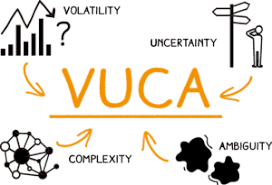

What will the 2020`s be. One thing for sure is that the world will be more and uncertain and volatile if the recent trends are extrapolated. It will be difficult to make any predictions, with a certain degree of certainty, beyond 3-4 years leave alone 10 years!!

During one of my recent travels I had the privilege of meeting the well-known ex- BBC journalist Nik Gowing and as we started talking our discussions went to a wide range of topics affecting the geo politics from USA – China trade wars, Climate change, events in India and many others.

Nik was kind enough to hand me a copy of his recent interesting book titled “Thinking the Unthinkable” which he has co -authored with Chris Langdon. They main point emphasized is that in the highly VUCA (Volatile, Uncertain, Complex and Ambiguous) world, the standard, normal tools and processes that have been used to address and resolve problems will be proved irrelevant and redundant in the new age as can be seen from many events in the near past. 

By presenting a context to the challenges, they drive the point that a new set of tools, frameworks and processes which can help managers to address and successfully take on the challenges of the new world. Some of their major observations are:

ü  The pace of change in the world is furious but isn’t necessarily bad but the results can be far reaching. The #MeToo movement caught up with such a frenzy that it engulfed a celebrity producer like Harvey Weinstein which was unthinkable. Facebook`s growth was unstoppable at one point of time in the mid 2010`s but suddenly got engulfed in the fake news scam and its share price dropped steeply. It took a good amount of management time, including the Senate hearing of Mark Zuckerberg, to address the shortcoming.

ü  Even though fitting a framework to address these challenges are difficult, the authors suggest a five-step sequential process, through which an organization can travel to address the change process– status quo, audit the external reality, audit the internal reality, address the challenges and thrive on changes.

ü  Leaders and managers today are too consumed by short termism and many times are so much in a comfort zone that they don’t see signals of the future. Governments too are blinded by short termism. The water crisis in the South African city of Capetown in 2018 is a good example. In early, 2018 the water crisis became so acute that a “Zero day- when the city would run out of water” was envisaged on 12th April which was averted by severe water rationing. In 2007-08, predictions were made of the impending water shortfall in the city but was avoided due to water rationing and good rainfall in 2013-15. Signals from subsequent rain shortages were met with no counter measures and political tangles at government level, ensured no effective actions, and hence leading to the crisis in 2018.

ü  Managers who have built their careers on conformity and not adapting to changes will find it difficult to cope up. Career Limiting Moves (CLM) which hamper managers career progress needs to be addressed so that they don’t become an impediment for managers to take decisions to adapt to changes. Some of the common symptoms affecting managers are Multiple intense pressures, Institutional conformity, willful blindness, group think and risk aversion.

ü  Apart from the standard Black Swan and Black elephant events, to describe the events which can be disruptive, the authors introduce the concept of black jellyfish events. Like a jelly fish which lurks somewhere and emits toxins, the jellyfish events are those which are simultaneous events which converge with innovation. An example is the like the Russian meddling in the US elections by which they subtly used the social media to plot news against Hillary Clinton without anybody realizing it. 

ü  Some of the changes and trends may not be ethically and politically correct but can change the way people think and act. In the 2016 USA elections, all analysts believed Hillary Clinton won all the three presidential debates but, yet she lost. She claimed that she ran a conventional presidential campaign, but Trump ran the elections shows like a reality show. He was also helped by the Russian meddling using the defamed UK firm Cambridge Analytica. Trump was not the conventional presidential candidate, but he won using questionable tactics. People voted for him!

ü  Senior managers need to look up to the millennials for their thoughts as well as advice. Millennials are not only concerned about the financial performances of firms but also the values and ethical conduct. The movement against climate change is a prefect example where teenage activitists like Greta Thunberg have caught the attention with their actions.

ü  The biggest challenge to leaders today comes from the technology especially from artificial intelligence which will change the nature of jobs as well as the ability to blow away existing jobs. Hence the challenge for the leaders would be to not only how to compete with the challenges of artificial intelligence but how to accommodate artificial intelligence to work with humans and importantly how to control the malicious intents of artificial intelligence. One of the important trends is that these technological advances can weaken the position of a conformist and non-adaptable leader.

ü  Hence firms need to build up cultures, behaviors and mind sets to address these challenges. Some of the traits that very important for managers for the future are having a sense of purpose, value systems, courage and humility.

ü  The way, the famed company Pepsi, addressed the change due to backlash against its “unhealthy” products is a great example. Its CEO, Indra Nooyi, drove the company`s performance with the slogan “Performance with Purpose” and deliver “sustainable long-term growth while leaving a footprint on the society and environment”. 

   
  The company addressed the issue by reducing the amount of sugar, salt and high saturated fat levels in its products. It also lessened its dependence on the Colas and moved towards everyday nutrition products that provide positive nutrients such as grains, fruit and vegetables, and protein, plus products that are naturally nutritious such as water and unsweetened tea. Secondly, it addressed the "guilt-free products" segment that includes everyday nutrition products plus diet beverages and other beverages.


Taking cue from the book, I was inclined to think what the challenges for could be the next few years- Technology march, Artificial intelligence, geopolitical uncertainty- the list is endless.My thoughts were shaken in the first 2 weeks of the year 2020- the assassination of Qasir Suleimani, Putin`s putsch in Russia, have shown what to expect in the next years. 

Can we predict what’s going to happen? Very difficult, though! However, we can be prepared for it by taking cue from the findings of “Thinking the Unthinkable” as slated by Nik Gowing and Chris Langdon.


References:
1.     Thinking the Unthinkable – Nik Gowing and Chris Langdon
2.     Thinking the Unthinkable website - https://www.thinkunthink.org/


Monday, 7 October 2019

My tryst with Himalayas and Climate Change


#sustainability, #climatechange, #environment, #annapurnabasecamp, #himalayas, #pollution, #reuse, #recycle, #reduce,#circulareconomy #Nepal, #Nepaltourism, #gretathurnberg


Last month myself, my wife Vani Narayanan and other friends from my running group in Mumbai, experienced the beauty and freshness of the Himalayas by trekking up to the Annapurna Base Camp (ABC). Over a period of 8 days- 5 days to climb up till ABC and 3 days to climb down, our enthusiastic team scaled an elevation of 4,100m and trekked close to 100kms with steep climbs up along narrow, rocky and muddy but pristine paths laced with breath-taking views of the Himalayas with stunning views of the various peaks like the Annapurna, Macchapuchare and Himchuli. The journey started from Pokhara (Elevation: 1,400m)- Ghandruk (1,940m) – Chumrong (2,040m)- Bamboo (2,190m) -Deurali (3,280m) and finally Annapurna Base Camp (4,100m).


 A breathtaking experience in the mountains....


The trudge in the mountains were inundated with various walks through clouds and splashes along mountain streams with spring fresh water and being treated to the various fresh local cuisines along the way.

For most of us used to staying in 5-star hotels across the world we had overnight stays in various tea houses with minimalistic facilities like cramped rooms for 3 people, common bathrooms, Rs. 200 paid hot shower, no TV, no free WIFI, limited mobile connectivity etc.

As we could carry only limited items due to weight restrictions all of us learnt the values of minimalistic living like reusing clothes for several days, washing and drying clothes overnight under mattresses and sleeping bags, reuse plastic covers, one shower per day, sharing our battery packs for charging our cameras as charging mobiles, etc. was a paid affair, etc. Importantly, instead of buying all our trekking material many of us borrowed from our ever-helping trekking friends’ networks - like bags, jackets, etc. or leased it from a mountaineering shop.

..Laced with some eye opening and humbling experiences

We all huffed and puffed carrying our 5-6 kg day packs along the route but our bags weighing about 10-12kgs were carried by the local porters who could carry about 2 bags each and walk at such a pace that they would reach the destinations well before we all did! Another eye-opening experience that we saw was that all material like some food material, fuel, construction material to the people, houses at the top of the mountains were carried by the local porters with many sights during our trek of these porters carrying LPG cylinders, steel rods, house doors weighing up to 20 kgs on their backs.

A humbling experience indeed for all of us who are used to all facilities and luxuries in life but, yet we complain about many things!! 

Global events in the background

As we were lost in the natural beauty of the Himalayas, at the he same time many events with sustainability and environment issues as the core occurred in the world. The UN climate conference debated the effects of climate change, marked By Greta Thurnberg` s emotional outburst, in which the usual issues of developed vs developing nations clashed with no clear solutions. The Indian government announced a roadmap to weed out single use plastic by 2022 to address the plastics pollutions issue and closer home we Mumbaikars saw the horrible spectacle of trees being cut down in Aarey forest – one of the lungs of Mumbai- overnight to make way for a metro rail shed.

Can mountain people preach climate change?


Obviously, the debate will go on to balance the needs of development to meet the ever-growing needs of people as against the menace due to the unbridled development leading to environmental issues, pollution, etc. which can affect the long-term sustainable development. I reflected to our learnings from the Himalayas trek to check whether these learnings can be applied to our “luxurious” day to day life styles.

Can the sustainability concepts, on which the life style of the people living in the mountains like Himalayas are based, and which our team embraced during the ABC trek – Reduce, Reuse and Recycle be embedded in the mind sets of the people across the world address the climate change and environmental issues?

My gut feel says yes!


What can we people do?

The recent backlash in support of environmental and sustainability issues indicates that this process might have started. Instead of having clothes for many single usage occasions can we all live with clothes just for our utility use and limited other usages and borrow clothes for special occasions? Many of us who spend all our working days in air-conditioned offices, cars, etc. – can we use our clothes more than once before washing and hence saving water usage, soap, power, etc.? Sharing platforms like Uber, Lyft and Ola have shown that we don’t need to own cars to commute. Recycled clothing, even for active sportswear, have been proved to be very similar to clothing made from virgin material from a utility and design perspective. Usage of recycled plastics in roads have proved to be very effective to lay durable roads.

Economic theories driving this change in consumer behavior?


Milton Friedman, the guru of consumption economics, propounded his Nobel Award winning theory of consumption economics in the 1970`s which drove the booming economies of the western world. However, the latest theories of “Sustainability” and “Circular Economy” propagate the perils of unabashed consumerism on the economies and hence highlight prudent consumerism. In short, these concepts highlight that the goods made are resent back to their roots for sustainable solutions and hence leave lesser footprints. If we use the same items more times, reuse and recycle like the people living in mountains do it would lead to a prudent usage of virgin material and hence prudent usage of water, power, fuels, etc. and hence lesser environmental issues and pollution issues and hence lesser climate change issues!

Thus, every policy maker dealing with climate change and environmental issues need to look up to people living in inclement conditions like the people in mountains and look up to them to address the environment issues. Hence at the next UN climate change summit, instead of listening to emotional and content less speeches like the one made by Greta Thurnberg, the organizers would be better off by inviting mountaineers and people living in mountains to speak!!!

Hail Mountains!! Hail Himalayas!!


Sunday, 7 July 2019

Modi 2.0 first budget: Paralleling China`s miraculous growth path

The latest budget presented by the new Modi government has set a very ambitious target for the Indian economy - reach a US $5 trillion GDP figure from the present US$ 2.7 trillion. If the present government targets to achieve this figure by the end of their term in 2024, as proposed, it would mean a real annual GDP growth of a staggering 13%!!!


China growth path, even though not openly admitted by the Indian government, obviously is one of the drivers for this budget. As the saying goes “If you can’t lick them join them “. China`s investment led development model with focus on mega factories, infrastructure, easy access to credit from financial institutions and attracting global investments which was backed by a strong government policy making machinery is evident as one of the key motivators of the Indian government`s initiatives.

Let’s look at some of the intent-based proposals in the budget which are very similar to what China did:

1.    Growth in fixed investment - Mega factories are being encouraged, very similar to the mega SEZ`s that powered China, to boost investment as well as create jobs that will in turn boost consumption. This initiative is also in tune with the “Make in India” initiative of the Prime Minister. However, this initiative is highly dependent upon the private investments which have been facing issues like land acquisition, high interest rates and poor infrastructure issues. External investors, who are being wooed, are still skeptical about investments especially when the global economic front is looking increasingly fragile.

2.    Infrastructure Development - The Indian government wants to give a massive boost to infrastructure - railway sector, roads, ports, airports and power and newly created water distribution. The railway infrastructure, which needs about Rs 50,000Cr, is proposed to be boosted with PPP`s the effectiveness of which however is still under a cloud.  Credit flow from the financial institutions, which are reeling from the excesses post 2009 crisis and the present NBFC crisis, is one of the key determinants for the success of the PPP initiative.

3.    Cheaper credit - China fueled its growth by making its banks lend indiscriminately to the borrowers leading to the wobbly banking sector very similar to what India is also facing now. Hence to bring down the interest rates the government proposes external borrowing by taking advantage of low and negative interest rates in many countries which will help the government to fund its projects at low rates.

4.    Focus on sustainability and green initiatives - Something that China missed and hence paying for its sins with its pollution problems in many cities. The Indian government is incentivizing Electric Vehicles (EV`s) which apart from giving push to the languishing car manufacturing industry will also address the sustainability issues. The government has also proposed a social exchange under SEBI which will address social development issues – something which will ensure a “equitable development” of the society.

5.    Focus on MSME and SME - These sectors are India`s answers to job creation and drive growth especially in the manufacturing sector. The government needs to address the issues of credit flow, labor movement before these sectors can boom.

Challenges that will be faced....

China based on the above model powered itself to the world`s second largest economy by following the above model from the 1980`s which bore fruit from the 2000`s. The Modi government similarly has laid the path for India becoming a $5 trillion economy by taking many cues from China. However, the point to be noted is that China took at least 10-15 years, during which it built its base like infrastructure, before it became a fast-growing economy. Secondly, China was ruthless in implementation of its objectives for which one of the major reasons was the single party rule. India will have its challenges as it’s a full-fledged democracy.

Long time back I came across a saying when I was working with a top-notch consultancy firm – “All strategy documents are a piece of toilet paper unless implemented properly”. The Modi government hence may take cue from it and focus on proper implementation and ground level reach of all its proposals. The ruling party has a majority in the Lower House - Lok Sabha and moving towards one in the Upper House – Rajya Sabha and hence if it has the will, can take India to its cherished dream of $5 trillion economy!

Hope for the best.

Saturday, 30 March 2019

“Smart Cities” initiative - Will it drive the economic growth of India?

As a part of my various geographical movements in my growing up years and career, 3 cities where I lived, have influenced my thoughts about economic development by developing cities and upgrading their infrastructure viz. Nagpur and Surat in India and Shenzhen in China.


I did my schooling in Nagpur in the 80`s. Nagpur at that time was considered an easy-going Tier-2/3 city and was mainly known for its oranges and the scorching summer. From the late 90`s and in the 2000`s thanks to the initiatives taken to upgrade the infrastructure and basic amenities, Nagpur today is one of the bustling cities in India with companies like Boeing setting up their base in the city. 

Surat in mid-90`s, was hit a plague, and considered one of the filthiest cities in India. Again, thanks to the clean up initiatives and infrastructure build up, Surat is one of the cleanest and most livable cities in India which has augmented its highly competitive textile and diamond industries. 

Shenzhen in China was a fishing village in the 60`s and upgraded to a city infrastructure to parallel Hong Kong. Today Shenzhen is one of the global hubs for technological innovation in the world and houses some of China`s premier telecom companies like Huawei and ZTE.

Well-developed city clusters drive growth through agglomeration effects...

All the major nations have several cities through which the growth has been driven. China has several cities, apart from Beijing and Shanghai, the economies of which are as big as many nations. 

Hangzhou, the capital of Zhejiang province, is a major bustling city which hosted the G-20 summit in 2016 while Shenzhen`s story is well known. The USA too has several cities which are global hubs and in fact all the major cities in the USA are good enough to host the Olympics! Economists refer to these benefits of city hubs as the effects of “agglomeration” which talks about the economic and social benefits of being in a cluster e.g. savings from common facilities like suppliers, common service providers, etc. City hubs also prove to sources of innovation due to the agglomeration effect like in the case of Bengaluru in India and Manchester for textile business in the 19th century. It has been seen that cities form and grow to exploit economies of agglomeration.

However, there are also negative effects of the agglomeration as once beyond a size the city hubs face issues like overpopulation, congestion, inadequate infrastructure, etc. A typical example is Mumbai which for the past so many years has seen traffic snarls, overpopulation leading to congestion and breakdown of infrastructure in monsoons. 

Benefits of city clusters are numerous…
Hence the solution for a country like India is to have many city/ urban clusters across the country. 

The major benefits would be:
Exploitation of the potential of the country from across and from the hinterland, 
Less congestion in the cities 
Mobility of people and facilities across these clusters and consequentially the country will have 
        many engines of growth which will propel the country`s development in a balanced way. 

Amongst global top 10 nations, India`s statistics are different…
Interestingly, amongst the top 10 countries in the world by GDP, India has the lowest proportion of urban population, as per World Bank figures. India`s figures at 33% compares abysmally low to China at 57% which has a similar population as that of India. 

All other major countries have an urban population of more than 75% with Japan topping the list at 91%. Another interesting fact is that the top 10 cities in India account for only 12% of the GDP while the similar statistic for China and USA stands at 24% and 34% respectively. This clearly shows the focus on building numerous city and urban clusters has powered the economic development of China and USA hence has reaped the benefits of “agglomeration”

 Another interesting piece of statistic is that the top 10 cities in USA and China account for 7.1% and 8.4% of the population while in India the similar figure is 5.5%! This is even though all top Indian cities are seemingly overcrowded as in Mumbai, Bengaluru, etc.!

Is there an opportunity for India? 
India`s masses live majorly in the tier-2, tier -3 and below towns and villages. Imagine the boost that the Indian economy can get by having different city hubs across the country which can harness the potential of the Indian hinterland. A city like Nagpur can harness the potential of nearby areas in the Vidarbha which else will have to reach out places like Pune or Mumbai. 


The “Smart City” initiative is an important initiative for India…
The Indian government`s “Smart City” initiative which was launched in 2016 aims to do the same. This initiative under a central flagship scheme allocated about US$ 14bn in the 2016 budget under which cities must compete to get the funding. In different rounds of voting about 100 cities have been identified under this scheme and SPV`s will be formed, with strict guidelines, headed by a CEO. 

The basis objective is to have a better access to basic facilities and core infrastructure to the citizens.
The success of the “Smart City” initiative is an important step in India`s equal and overall development. Imagine in the next 10 years we have about 10 cities which can vie to organize important events like the Olympics, Asian Games, global conferences, etc.!! Imagine people opting to work in places like Raipur, Lucknow, etc. as compared to Mumbai and Delhi now. 

“Smart City’ initiative if it succeeds will take India`s economic growth to a different level!!

Sunday, 16 September 2018

Michael Porter and the Indian Cricket Team


As India capitulated to one other overseas cricket series defeat to England last week, any Indian cricket fan is bound to ask the question – why again after coming so close? It’s not that the Indian team has been vanquished by the English cricket team, as the Indian team was in a strong position in all but one of the tests. The Indian team, ranked no.1 in test cricket, had all the elements at its disposal – a limited overs series before the tests so as to acclimatize to the conditions, a supposedly great team with the world`s best batsman as its aggressive leader, a great fast bowling unit, many of the players having played in England before, etc. Like Jerry Mcguire asked “Show me the money”, the Indian cricket fans are asking “Show me the victories”.

I as a corporate professional and an avid cricket fan tried to analyze the possible reasons for the Indian cricket team`s failure to win series abroad using a framework (what else can typical MBA`s do?) – Global Management guru Michael Porter`s value chain framework. Porter`s value chain framework analyzes the performance of a firm as a portfolio of activities. Applying the same concept I have tried to analyze the Indian team`s performance based on their main activities and support activities. Scores have been attributed to the various elements with green – positive, grey – neutral and red – negative.

After analysis Porter`s value chain framework for the Indian test team reflects as below:


Main Activities

1.     Preparation (Score : negative)

The Indian team made some structured efforts but did not have a comprehensive preparation for a difficult tour like England`s. Some players like Pujara, Ishant Sharma and Ashwin played in the county league to get used to conditions and hence they were able to perform decently well. However the Indian didn’t play enough practice matches to get used to the conditions and hence repeated the same mistake that they did before the South African series as well as the last English tour in 2014. Infact the Indian team cut short a practice match ostensibly so that they don’t tire themselves!

The other strategy adopted for getting match practice was to play the limited overs series before the tests. But hey, white ball cricket is a different proposition from red ball cricket, especially in England, where the red ball swings more. Poor preparation indeed! To add to the misery most of the players were just back from a grueling IPL.

2.     Bowling : (Score : positive)

As discussed earlier, after a long time the bowling team is consistently bowling out opposition teams in overseas tours as evident with the present English tour and the previous South African tours. Both the fast bowlers as well as the spinners are able to consistently put the opposition under pressure in various conditions. In the present tour as well as the South African tour, there have been superlative performances by the pacers as well as by the spinners like Ashwin`s in the first test and Jadeja in the last test of the English series.

3.     Batting (Score : negative)

With the exception of the Nottingham test, the Indian batters could not put decent scores to put England under pressure. India now produces excellent white ball batsmen like Shikar Dhawan, Hardik Pandya, etc. but except for Virat Kohli and to some extent Cheteshwar Pujara and Ajinkya Rahane, Indian batters cannot last in tough overseas conditions in tests with the red ball. Most of the batsmen, so used to playing limited overs cricket in docile Indian pitches, don’t have the skills sets to bat in bowler friendly wickets and surprisingly are unable to play spin too.

4.     Fielding (Score : neutral)

Most of the Indian players are excellent outfielders but poor slip fielders – again effect of limited overs cricket. With the exception of KL Rahul, the close in fielders have poor catching skills. On top of that India also faces a genuine problem of lack of quality wicket keepers as seen by the pathetic display of both Dinesh Kartik and Rishabh Pant in the absence of Wriddhiman Saha.


Supporting Activities

a.     Coach & Support Staff (Score : neutral)

Ravi Shastri was an average player in his playing time but it is man management skills which has probably got him the job and not his technical. As a compared to a tough no nonsense but technically sound coach like Anil Kumble, Ravi Shastri is holding on to the job just by pleasing Virat Kohli. However in tough and crunch conditions, key critical and tough inputs which needs to be sent by Shastri seems missing which a technically more competent coach would do. Also repeated blunders in team selection shows Shastri in poor light. Similarly with the lack of test batting skills in the Indians, the team needs a highly technical batting coach like probably Rahul Dravid as compared to Sanjay Bangar.


b.     Team composition and skillsets  (Score : neutral)

India probably is the only team which can boast of a vast bench strength thanks to IPL which has thrown up new talent like Rishabh Pant, Vihari, etc. Fast bowling department, which used to India`s weak link, has an array of excellent talent with wide array of talent to choose from. Gone are the days in the 80`s when India had only Kapil Dev to bank upon.

However in tough overseas conditions, India`s main weakness has been in their traditional strong base – batting. Indian batsmen`s technique are good for limited overs and home conditions but are suspect in overseas conditions. The other major problem has been lack of quality openers with Murali Vijay and KL Rahul having the technique but unable to perform consistently while Shikar Dhawan is good only in one day cricket.  Yes, there are very few quality test batsmen globally now but India should be better off considering the amount of talent available and money involved in cricket.
              
c.      Execution / Attitude (Score : neutral)

While the team`s urge to win isn’t under doubt, the ecosystem in the team also needs some introspection. One of the issues has been the constant team change by Kohli which probably has affected the morale of some players. Kohli `s captaincy too has been average in crunch situations especially in field placements in critical situations and also his dominant attitude is also leading to issues in the team. 

The team selection process too leaves much to be desired especially in the Lords test by playing Kuldeep Yadav and not playing Cheteshwar Pujara in the first test the blame for which lays on the coach and captain. Lastly, the players of today don’t seem to like the Test cricket, with the exception of a few, thanks to other money spinners like IPL, one dayers, etc. The new bunch of players loathe the tests and is evident in their approach.

To conclude, Indian test cricket has a major structural problem thanks to IPL, limited overs cricket, coach – captain influence on the team and lack of focus on preparation. India probably will remain as no.1 test team thanks to wins in India and focus will shift to one day’s cricket once they win tournaments. But still... I leave it to the readers to judge.

Sunday, 22 July 2018

Online Poll results : Trends from the "No confidence motion" debate against the BJP government


The entire nation was glued to the Indian parliament`s proceedings on 20th July`18 with the debate on the “No confidence motion" brought against the incumbent BJP government by the opposition parties. The motion was rejected soundly as expected. 

An online poll, conducted by me, had four questions on the aftereffects of the proceedings with an eye on the 2019 poll. The trends are not unusual but has some interesting for the 2019 general elections.

Disclaimer : This poll had respondents from various parts of India and other countries across the globe and can have a distinct urban bias.

Poll results
The poll results from the 4 questions:

1)      Who was the real winner of the No confidence motion?


2)      Has the BJP 's 2019 poll prospects increased after this no confidence motion?


3)      What’s your reaction to Rahul Gandhi's action of hugging Narendra Modi?


4)      How was Narendra Modi's speech on the no confidence motion?


Poll Analysis

The poll results have shown that the opposition parties, led by the Congress, have erred in moving the “No confidence motion” against the BJP government. On the other hand, it can be said that this was a symbolic move by the opposition and the results were expected. In 1989 the combined opposition led by VP Singh did the same against the Rajiv Gandhi government, which had a brutal majority in the Parliament, and riding on the wave VP Singh managed to defeat Rajiv Gandhi in the 1989 polls. 

This poll results clearly show the following trends in the lead up to the 2019 general elections:
  • As the online polls indicate, Narendra Modi has emerged as the clear winner from this no    confidence motion and hence remains the undisputed tallest leader in the country with the    opposition`s mascot Rahul Gandhi no match for him. Rahul Gandhi`s antics in hugging Modi have   earned him more negative publicity rather than support his message of “Love for all including enemies”!
  • It’s time the Congress introspects and parade other young and capable leadership alternatives like Jyotiraditya Scindia and Sachin Pilot. This also indicated that other opposition big guns like Mamta Banerjee, Mayawati and Akhilesh Yadav will vie for the combined opposition leadership spot and thus create a ruckus amongst themselves. It will also support the BJP`s assertion that there are too many claimants for the opposition`s leadership spot and thus it will be a “unstable alliance.”
  • The BJP too has quite a task cut out for the 2019 polls as indicated by the poll. Despite Modi`s tallest Indian leader image being enhanced after the no confidence motion, about 25% of the respondents indicate that BJP`s 2019 poll prospects have not increased after the debate. 
  • Interestingly, about 23% of the respondents indicate that Modi`s speech had nothing new and was “drumbeating of same old issues” like GST implementation, undoing 70 years of Congress rule,clamp down on black money,etc. This indicates that the BJP government in the time left has to show some semblance of real action like cutting down on fuel taxes, bring back some of the black money stashed in Swiss accounts, improve the day to day standard of living of common people, etc. 


     Tough task ahead for Modi and the BJP but they have shown the will to take tough actions. Will they now?